A 2027 Sky Calendar, Drawn for Your Town
Type a town and a year and the list above names the nights worth circling there: the strongest meteor showers with a verdict on the Moon, every eclipse that can be seen from that spot, the nights Mars, Jupiter and Saturn are opposite the Sun, and the supermoon. The button prints the whole year the same way: a cover, then one page per month with that month’s sky over the town, a grid of every night’s Moon and those events written into their squares.
Open the Copenhagen 2027 calendar, then change the town
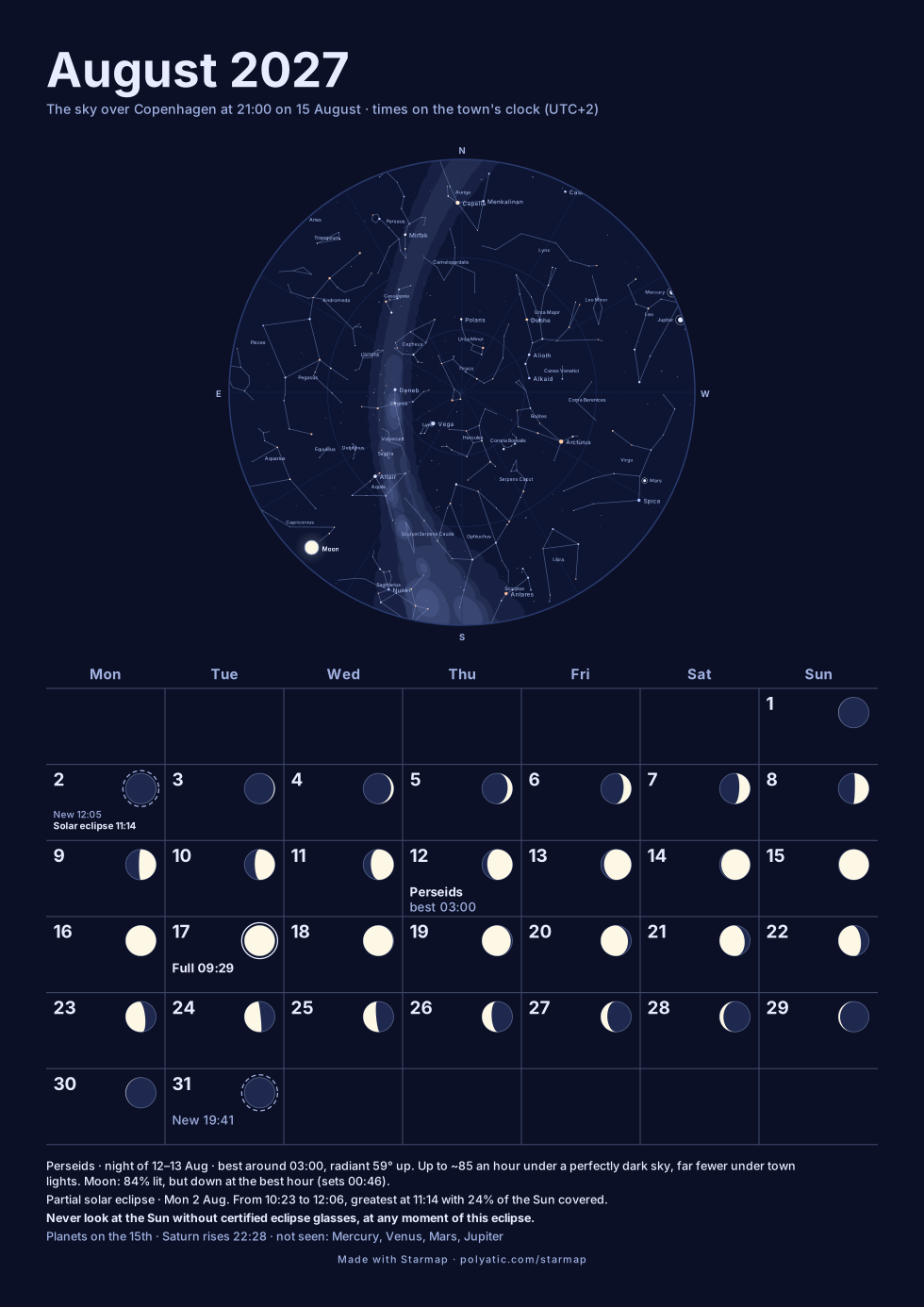
Free and made in your browser: no account, nothing uploaded, nothing to buy. This link opens the generator on the Copenhagen calendar the sample below comes from; the form at the top opens it for your own town and year instead. Download PDF writes all thirteen pages at the sheet size you choose, A4 (21 × 29.7 cm), A3 (29.7 × 42 cm) or US Letter (8.5 × 11 in); the PNG, JPG and SVG downloads are the cover alone.
Why an event list in Universal Time is not your calendar
Almanac pages and printable astronomy calendars give each event one date, usually in Universal Time (UT) or in the publisher’s own zone. An event is an instant, though, and the square it belongs in depends on your clock. The penumbral lunar eclipse of February 2027 is greatest at 23:13 UT on 20 February: that is 23:13 on the 20th in London, but 00:13 on the 21st in Copenhagen and 18:13 on the 20th in New York, when the Moon has only just risen there. Jupiter reaches opposition at 00:59 UT on 11 February, which in New York and Los Angeles is still the evening of the 10th. The supermoon of 22 January, the year’s closest full Moon at 357,644 km, is full at 13:17 in Copenhagen, 07:17 in New York and 23:17 in Sydney. A sheet printed in UT puts a few of these on the wrong day for almost everyone, and gives no hint which ones.
What changes from town to town
Meteor nights. The Geminids peak at 19:50 UT on 14 December 2027. In Copenhagen that is 20:50, early in the evening, so the night to watch is 14–15 December, with the best hour around 02:00. In New York the same peak comes at 14:50, in daylight, and the night before, 13–14 December, is the one that carries it. The rule the list uses: the peak night is the one whose morning has the peak’s local date, unless the peak falls after 16:00 local time, when that evening’s night is nearer. A shower can also simply not be there: the Perseids radiant never rises into a dark sky from Sydney or Cape Town, and the list says so instead of promising 85 an hour.
Eclipses. Only the eclipses visible from the town are listed. The solar eclipse of 2 August 2027 is total for about four and a half minutes in Tarifa, covers 42 % of the Sun from London at 10:00 and 24 % from Copenhagen at 11:14, and is not seen at all from New York or Sydney. A penumbral lunar eclipse, a faint grey shading most people never notice, is labelled as exactly that.
The Moon. Moonrise and moonset move with longitude and latitude, and they decide whether a meteor peak is worth staying up for. On the Perseid night of 12–13 August an 84 % Moon sets at 00:46 in Copenhagen, 01:13 in London and 02:17 in New York, each before that town’s best hour, so the verdict is fair rather than poor. On the 2027 Geminid night the Moon is 97 % lit and up until dawn everywhere: a bad year for the Geminids, and the list says it plainly.
The planets. Oppositions happen on the same date for nearly everyone, but how high the planet climbs does not. On 19 February 2027 Mars is opposite the Sun at magnitude −1.3; it stands 50° up in the south from Copenhagen around 00:30, 65° up from New York, and 41° up in the north from Sydney and Cape Town.
What the printed calendar holds
- The cover: “2027 · The sky over <your town>”, or your own title, over a chart of the sky on the date and time in the generator, and one paragraph saying what the months contain.
- Twelve month pages: the sky over the town at 21:00 on the 15th, then a month grid (Monday first on A4 and A3, Sunday first on US Letter) with each night’s Moon drawn lit and turned as it hangs at 21:00, the new and full Moon times, meteor peaks with their best hour, and eclipses. Under the grid: the meteor and eclipse lines, the eye-safety sentence for any solar eclipse, and where the bright planets are on the 15th.
- Paper: A4, A3 or US Letter, portrait; print the PDF at 100 %, not “fit to page”. The ink and sepia themes print the same pages on a light ground and use far less toner than the navy default.
Honest limits
Meteor rates are upper bounds for a perfectly dark sky with the radiant as high as it gets; under suburban light expect roughly a quarter. Clouds are not forecast. Planets are described on the 15th of each month only, so a fast mover like Mercury can be in a different part of the sky by the end of it. Oppositions are given to the day. The calendar is drawn for any year from 1900 to 2100, the span of its meteor table; the town list covers every place of 1,000 people or more.
For the phases alone on one big sheet, see the printable Moon calendar; for the next twelve months of showers with an hour-by-hour bar, the meteor showers from your town; for every eclipse to 2035, eclipses from your town.
What the chart draws
The chart holds the 1,630 stars brighter than magnitude 5.0 and the 89 constellation figures, and the Milky Way is drawn as a soft band. The Moon is drawn in its real phase, and left off when it was below your horizon. The five naked-eye planets, Mercury, Venus, Mars, Jupiter and Saturn, are drawn where they stood. The Sun is drawn too whenever it was up, and the caption says whether your moment was daylight, twilight or full dark: the stars are always drawn where they stood, even when daylight or twilight hid them. So is an eclipse, if your moment falls inside one. Uranus, Neptune and 133 deep-sky objects are one switch away: tick Deep-sky objects and the chart marks the Messier objects and southern showpieces and adds Uranus and Neptune (see this page’s example with them). Great comets since 1900 can be added (Hale-Bopp over London, 1997). Not drawn: faint comets and satellites, whose orbits this tool does not compute. Every position is carried to your date by precession. Not modelled: the stars’ own proper motion. A date before 15 October 1582 is read in the Julian calendar. It all runs in your browser, nothing is uploaded, and the downloads are complete and free. Accuracy, print sizes and privacy, answered in full.
Common questions
How is this different from a 2027 astronomy event list in UT?
An event list gives one date per event, in Universal Time or one publisher’s zone, and the same events for everyone. This calendar is worked out for one town: each date and time is on that town’s clock, only the eclipses visible from there are on it, a meteor shower whose radiant stays below the horizon is marked as such, and the Moon on each meteor night is judged by when it rises and sets there.
Which time convention does it use?
Local civil time of the town in the box: its time zone, with summer time switched on and off on the right dates (Copenhagen is UTC+1 until 28 March 2027, then UTC+2 until 31 October). Each month page names the offset it uses. A meteor night is named by both dates, evening and morning; it is the night whose morning carries the peak’s local date, unless the peak comes after 16:00 local time.
Why are the Moon times different for my town?
The new and full Moon are single instants, so only their clock time changes with your zone. Moonrise and moonset are different: they depend on where you stand, by several minutes for every degree of longitude and by much more at high latitudes. On the Perseid night of 12–13 August 2027 the Moon sets at 00:46 in Copenhagen and 02:17 in New York, local time, which is why each meteor row has its own Moon verdict.
Why does the Geminid night differ between towns?
The 2027 peak is at 19:50 UT on 14 December. Where that falls in the evening, as in Europe, the night of 14–15 December holds it; where it falls in daylight, as in New York (14:50), the night of 13–14 December is closer to it. The list shows the right night for the town in the box.
Does it cost anything, and is anything sent?
No to both. The list and the calendar are computed in your browser; the first town is guessed from your device’s time-zone name, never from your location, and the town list loads only when you type. The PDF, PNG, JPG and SVG downloads are free.