Every Eclipse From Your Town, to 2035
The list above starts on a town guessed from your device’s time zone; type your own and pick it, and the list is redrawn with every solar and lunar eclipse you can see from there between 2026 and 2035: the date and times on your town’s own clock, how much of the Sun is covered or how deep the Moon goes into the Earth’s shadow, how high it stands, a small drawing of the maximum as it looks from your town, and a link that makes a star-map poster of that moment.
Open totality over Tarifa, 2 August 2027
Free, in your browser — no account and nothing uploaded. The button opens the generator on the poster shown below; the town box at the top lists your own town’s eclipses instead, each with a link to its poster. Downloads: a vector SVG, a 300 dpi PNG and a PDF at the real size you pick.
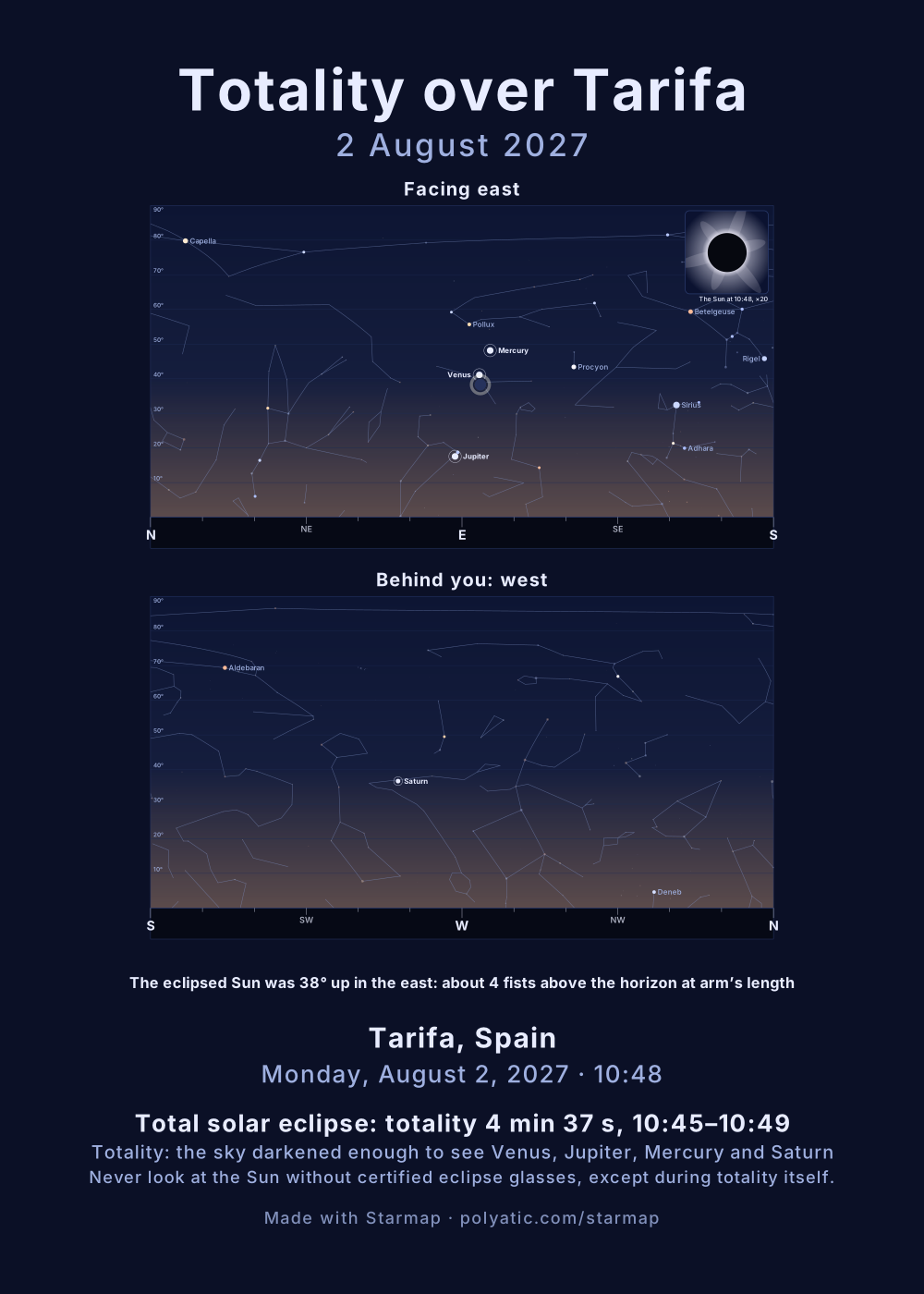
Never look at the Sun without certified eclipse glasses, except during totality itself. That holds at 99 % too: the thin crescent left is still bright enough to burn the retina, and it does not hurt while it happens.
2 August 2027: who sees totality, and who sees a crescent
On the morning of 2 August 2027 the Moon’s full shadow crosses the Strait of Gibraltar, runs along the North African coast and up the Nile, and leaves land over Arabia. Only inside that band, some 200 to 260 km wide, does the Sun disappear completely. Everywhere else in Europe, North Africa and the Middle East it is a partial eclipse, and the share of the Sun that goes dark falls quickly with distance from the band. These are the list’s own figures for a few towns, times on each town’s clock:
- Tarifa, Spain: total for 4 min 37 s, maximum 10:48, the Sun 38° up in the east.
- Cádiz: total for 2 min 46 s; Málaga: 1 min 38 s; Tangier: 4 min 50 s at 09:47 Moroccan time.
- Luxor, Egypt: 6 min 22 s at 13:05 with the Sun 82° up, close to the longest anywhere on this eclipse; Jeddah: 5 min 54 s at 13:26.
- Seville: 98 % of the Sun covered. Madrid: 86 % at 10:51. Lisbon: 92 %. Rome: 74 %. Paris: 51 %. London: 42 % at 10:00. Copenhagen: 24 %.
The difference between 98 % and totality is not two per cent of anything you notice. At 98 % the day turns dim and strange but stays day; only in totality does the sky go dark enough to show Venus and Jupiter, the corona appear round the black Moon and the horizon glow orange all the way round. The poster above is Tarifa at 10:48, drawn that way.
Why the times change from town to town
The Moon’s shadow moves. It touches the Earth near the Atlantic at sunrise and sweeps east, so the maximum comes later the further east you are: 08:47 Universal Time in Cádiz, 08:51 in Madrid, 10:05 in Luxor. Time zones then add their own offset, which is why the list shows each time on your town’s clock with its offset beside it (Madrid in August is UTC+2, so its maximum reads 10:51). The amount changes too: the path of 12 August 2026 put Burgos inside totality for 1 min 44 s while Madrid, 210 km south, stopped at 99.9 %.
A lunar eclipse is the other way round. The Moon really goes dark in the Earth’s shadow, so every place where the Moon is up sees the same thing at the same instant. The total lunar eclipse of 31 December 2028 peaks at 17:52 on every clock set to UTC+1, from Madrid to Berlin, and at 16:52 in London and Lisbon. What differs is whether the Moon has risen: in Madrid it comes up a minute after the peak, so the row says the Moon is below the horizon at maximum and gives the part you can see, and its poster link opens at 17:54, the deepest moment you can actually watch.
Reading a row
- Solar: the share of the Sun’s area the Moon covers at maximum (obscuration). NASA tables often give the magnitude instead, the share of the Sun’s diameter: Madrid’s 86 % of area in 2027 is a magnitude of 0.88. A total or annular eclipse gives the length of totality or of the ring instead.
- Lunar: the umbral magnitude, the fraction of the Moon’s diameter inside the Earth’s dark shadow. Above 1 the eclipse is total and the Moon turns copper; between 0 and 1 a dark bite; below 0 only the faint outer shadow touches it (a penumbral eclipse), which most people never notice.
- Altitude: how high the Sun or Moon stands at maximum, for the true position without the air’s bending. Under 5° a hill, a wood or a block of flats may hide it.
From Madrid the list has 22 rows to the end of 2035, 5 of the Sun and 17 of the Moon; from New York 18, from Sydney 17, whose one total solar eclipse comes on 22 July 2028 with 3 min 43 s of totality at 14:02. The 2026 rows that have already happened stay on the list, because the poster of an eclipse you saw is the reason many people come.
How it is computed, and how far to trust it
Nothing is looked up in a table. Your browser computes where the Sun and Moon stand as seen from your town, and finds each contact and the maximum to the second, with the same engine that writes the eclipse line on every poster. It is checked against NASA’s own local-circumstances calculator: for Burgos on 12 August 2026 both give 1 min 44 s of totality, and for Madrid on 2 August 2027 NASA gives 86.3 % of the Sun covered and this page 86.2 %. Contact times are rounded down to the minute, as a clock reads; the maximum is rounded to the nearest minute. It assumes you stand at sea level and that the Moon’s edge is smooth, so at the very edge of the path of totality allow a few seconds either way. Clouds are not modelled at all.
What the poster of that moment draws
Each row’s link opens the star-map generator on your town at the eclipse’s maximum: a solar eclipse in the Horizon view, facing the Sun, with the sky dimmed by the share of the Sun that is covered (dark as deep twilight in totality), a lunar eclipse on the round chart of the whole sky. The caption names the eclipse and its times, and a solar one carries the eye-safety sentence. Title, colours and size are yours to change. The stars are the 1,630 of the Yale Bright Star Catalogue, every one a good naked eye can see, carried to the eclipse’s date by precession. The stars’ own proper motion is not modelled, which over the decade this list covers moves none of them by a visible amount. The generator reads any date before 15 October 1582 in the Julian calendar, should you make a poster of a historical eclipse. The Milky Way is drawn as a soft band under the stars, five steps from its faint edge to its brightest star clouds, and clipped at the horizon like everything else. Its centre line is the galactic equator, computed with the same math as the stars, so it runs where the sky has it: through Cygnus, Aquila and Sagittarius in a northern summer, through Auriga, Gemini and Puppis on a winter night. Its edges and star clouds are a hand-drawn sketch of the naked-eye band, not a traced photograph, so treat them as a guide to where to look, not a brightness map; a checkbox turns the band off. The Moon is drawn at its real altitude, azimuth and phase for your moment, and left off entirely when it was below your horizon. So are the five naked-eye planets: Mercury, Venus, Mars, Jupiter and Saturn are drawn where they stood, sized by how bright each was that night, labelled, and shown only when above your horizon. The Sun is drawn too whenever it was above your horizon, and the line under the chart says whether that moment was daylight, civil, nautical or astronomical twilight, or full dark, with the Sun’s altitude: the stars are always drawn where they stood, even when daylight or twilight hid them. If your moment falls inside a solar or lunar eclipse seen from your place, the eclipse is drawn as well: the Moon over the Sun, to scale, or the Moon in the Earth’s shadow. Uranus, Neptune and 133 deep-sky objects are one switch away: tick Deep-sky objects and the chart marks all 110 Messier objects and 23 southern and binocular showpieces (Omega Centauri, 47 Tucanae, both Magellanic Clouds, the Carina Nebula and more) with star-atlas symbols and labels such as M31 and M42, and adds Uranus and Neptune — open this page’s example with it ticked. Most of them are binocular targets: only a handful, such as M31, M42, M45 and Omega Centauri, show to the naked eye from a dark site, Uranus (about magnitude 5.7) only to a sharp eye, and Neptune (about 7.8) only in binoculars. Great comets since 1900 can be added (Hale-Bopp over London, 1997). Not drawn: faint comets and satellites, whose orbits this tool does not compute.
For one night drawn as the Moon looked, see the Moon the night you were born; for the whole sky at a past moment, what the sky looked like.
Common questions
Does the list know if it will be cloudy?
No. Clouds and weather are not modelled; every row assumes a clear sky. Look at a forecast in the days before, and for a total eclipse it is worth having a second place within driving distance.
Why is the time for my town different from the one in the news?
Because the Moon’s shadow moves across the Earth, each town has its own start, maximum and end, and news reports usually give one city’s times or Universal Time. On 2 August 2027 the maximum is 10:47 in Cádiz, 10:51 in Madrid and 13:05 in Luxor, each on local clocks.
Is it safe to look at a 99 % eclipse?
No. Never look at the Sun without certified eclipse glasses, except during totality itself. Only when the Moon covers the whole Sun is it safe to look without them, and they go back on the moment the first bead of sunlight returns. Sunglasses are not eclipse glasses.
What is umbral magnitude?
The fraction of the Moon’s diameter inside the Earth’s dark shadow at the eclipse’s peak. The total lunar eclipse of 31 December 2028 reaches 1.25, so the Moon is deep inside the shadow; a negative value means only the faint outer shadow touches it.
Why does the list stop at 2035?
The calculation is built and tested for 2026 to 2035. The generator itself draws any moment from the year 1 to 3000, and a poster made at any eclipse in that range still shows it.
Is anything sent anywhere?
No. The calculation loads into your browser with the page, the town list once you start typing, and the eclipses are worked out on your own device. The first town is guessed from your time zone’s name alone, never from your location. There is no account.
How far is totality from my town, and why do other sites give a few seconds more?
Each total or annular eclipse in the list says how far its path is from your town: the straight-line distance to the nearest point of the path’s edge and the direction to it, then the nearest larger town inside the path, with that town’s own duration. When that town is near the edge, with under 90 % of the central line’s duration there, it also names the nearest town that gets at least 90 %, and the poster link goes there. Over 2,000 km it names the nearest country the path crosses instead. Every edge and duration here uses the IAU lunar radius, k = 0.272281 Earth radii, the convention of NASA’s eclipse canon, which measures the Moon to the floors of the valleys on its edge. Sites using the larger mean radius (0.2725076) draw a slightly wider path and can list up to about 20 s more near its edge. Near the edge totality shrinks fast: on 2 August 2027 Málaga, 7 km inside the northern edge, gets 1 min 38 s while the central line gets 4 min 56 s. So when a town is within 10 km of the edge or gets under half the central line’s duration, the line says to go further in and names the nearest town with at least 90 % of it.