The Geminids 2026 From Your Town
The card above is the night of 13/14 December 2026 for the town in the box, which starts as a guess from your device’s time zone. Every time on it is on that town’s own clock, the bar shows the most you could hope to count in each hour from 18:00 to 07:00, and its two buttons open a chart to print for the best hour or a poster of the same sky.
Open the Geminids chart for London, 14 December 2026 at 02:00
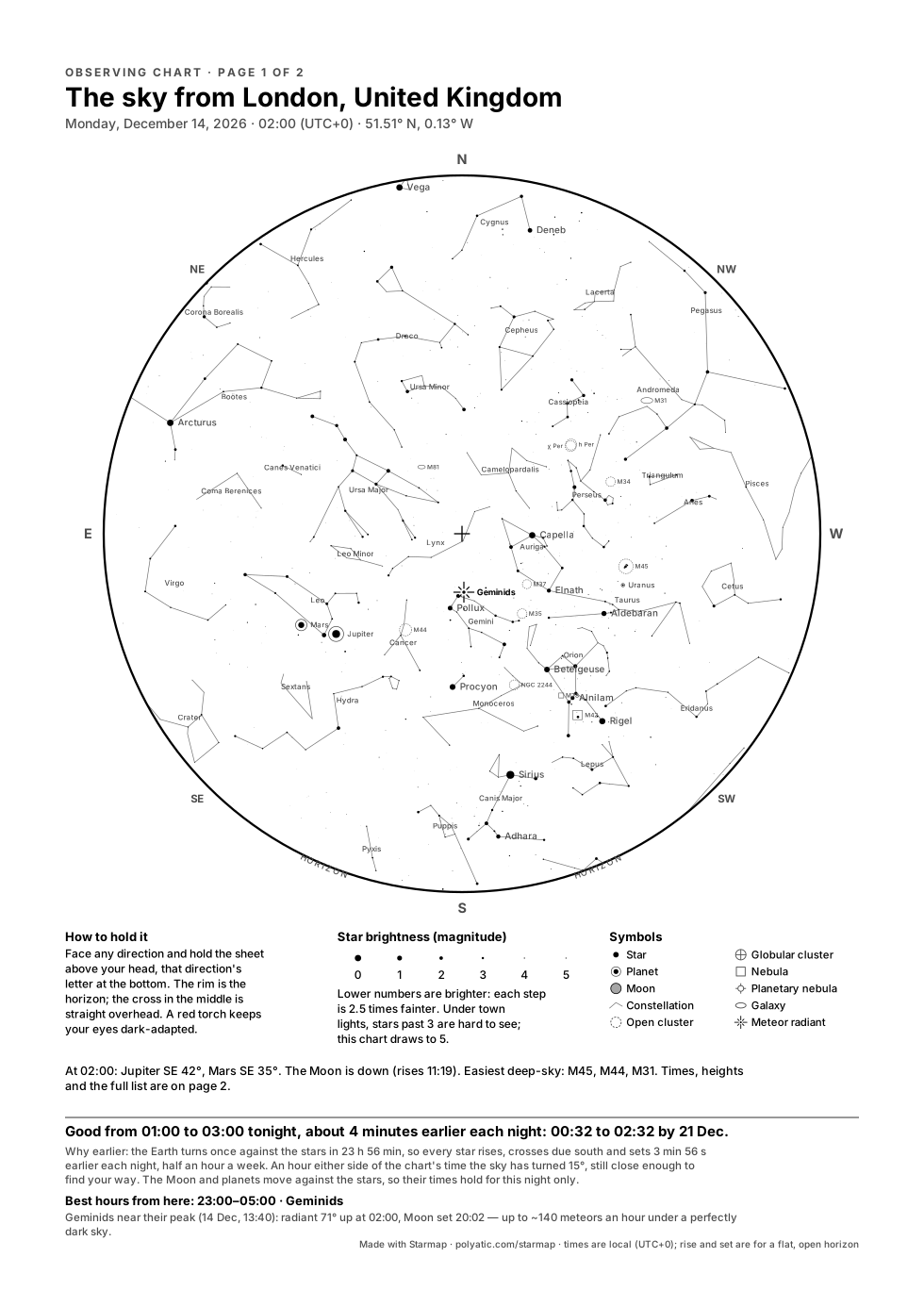
Free and worked out in your browser: no sign-up, nothing sent. This opens the Observing chart pictured below, radiant marked; the card at the top of the page opens the same chart for whichever town is in the box. It prints on one A4 (21 × 29.7 cm) or US Letter (8.5 × 11 in) sheet, or downloads as an SVG, a 300 dpi PNG or a PDF.
What the Geminids are
Most meteor showers are dust from comets. The Geminids are not: their parent is 3200 Phaethon, a rocky body about 5 km across found in 1983 in data from the IRAS infrared satellite. Phaethon goes round the Sun every 1.4 years and swings in to about 0.14 of the Earth’s distance from it, well inside Mercury’s orbit, where it is heated enough, it is thought, to crack and shed grit. The Earth crosses that stream of grit every December; this time the densest part comes at 13:40 UT on 14 December 2026.
The International Meteor Organization gives the Geminids a zenithal hourly rate of 150, the highest of any annual shower. They hit the atmosphere at about 35 km/s, against 59 km/s for the Perseids and 71 km/s for the Leonids, so they are slow: a Geminid crosses a good stretch of sky in a second or so, easy to follow with the eye, and many are bright and yellow-white rather than quick streaks.
Why after 22:00? Every Geminid seems to fly out of one point beside the star Castor, the radiant, and the number reaching your patch of sky scales with how high that point stands. From London it rises at 16:17, but at 20:00 it is only 26° up and a perfectly dark sky would give at most 65 an hour. By 22:00 it has climbed to 44° (up to 105), and it is highest at 01:57, 71° up in the south. Unlike most showers the Geminids are already worth watching before midnight, but the hours either side of 02:00 are the richest.
13/14 December 2026: the Moon is out of the way
The Moon is a 21 % lit waxing crescent that night. From London it sets at 20:02, from New York at 20:42, so for most of the northern hemisphere every hour from mid-evening to dawn is moonless. That is the best a Geminid peak gets: in 2027 the Moon is almost full on the same night (see the table below). London’s best hour is 02:00, with up to 140 an hour under a truly dark sky; New York’s radiant stands 82° up at 01:53, nearly overhead.
From the southern hemisphere
Yes, you can see them, but fewer. The radiant sits 33° north of the celestial equator, so south of the equator it rises late and never climbs far. From Sydney it comes up at 22:35 and peaks at only 23° above the northern horizon at 02:52; from Cape Town 23°, from Auckland 20°. With the radiant that low, even a perfect sky over Sydney gives at most about 60 an hour at 03:00, roughly 41 % of London’s figure. There is nothing worth doing before Sydney’s radiant rises; the window is the five or so hours from about 23:00 to the first light of a short December night. Face north, and expect the meteors to come up out of the northern horizon. Below about 57° south the radiant never rises at all.
The next three Geminid nights
The peak moves about six hours later each year (a year is 365¼ days) and jumps back after a leap day, so the night it falls on shifts. What changes most is the Moon:
| Year | Peak (UT) | London’s night | The Moon from London | Sydney’s night |
|---|---|---|---|---|
| 2026 | 14 Dec, 13:40 | Sun 13 → Mon 14 Dec 2026 | Good: the Moon (21 % lit) sets at 20:02, leaving the rest of the night moonless. | Mon 14 → Tue 15 Dec 2026; 26 % Moon |
| 2027 | 14 Dec, 19:49 | Tue 14 → Wed 15 Dec 2027 | Poor: a bright Moon (97 % lit) is up all night and hides the fainter meteors. | Tue 14 → Wed 15 Dec 2027; 99 % Moon |
| 2028 | 14 Dec, 01:59 | Wed 13 → Thu 14 Dec 2028 | Good: the Moon (5 % lit) rises at 06:26, after the best hour (02:00). | Wed 13 → Thu 14 Dec 2028; 7 % Moon |
| 2029 | 14 Dec, 08:08 | Thu 13 → Fri 14 Dec 2029 | Fair: the Moon (63 % lit) sets at 01:23; the best hour, 02:00, comes after it. | Fri 14 → Sat 15 Dec 2029; 68 % Moon |
Each row is computed from the solar longitude of the peak in the IMO’s 2026 list, assumed the same each year. The card at the top lists the same three nights for the town in the box.
How to use the night
- Dress for hours, not minutes. December nights are cold in the north; a reclining chair and a sleeping bag do more for your count than any equipment. Binoculars and telescopes are no help: their field is far too small.
- Give your eyes 20 minutes. One look at a phone screen undoes it. The printed chart is black on white for that reason; read it by a red light.
- Look about half-way up, away from the radiant. Meteors near the radiant are short; the long ones are 40° to 60° from it.
- Count in a dark place. Under a suburban sky about a quarter of the dark-sky rate is left; in a city centre, a tenth.
The chart and the poster draw the 1,630 stars of the Yale Bright Star Catalogue with the radiant marked for your moment, each star moved to the night’s date by precession. Proper motion, each star’s own slow drift, is not modelled; between now and 2029 it shifts none of them by an amount the eye could see. Should you chart a historical Geminid night, any date before 15 October 1582 is read in the Julian calendar. The Milky Way is drawn as a soft band under the stars, five steps from its faint edge to its brightest star clouds, and clipped at the horizon like everything else. Its centre line is the galactic equator, computed with the same math as the stars, so it runs where the sky has it: through Cygnus, Aquila and Sagittarius in a northern summer, through Auriga, Gemini and Puppis on a winter night. Its edges and star clouds are a hand-drawn sketch of the naked-eye band, not a traced photograph, so treat them as a guide to where to look, not a brightness map; a checkbox turns the band off. The Moon is drawn at its real altitude, azimuth and phase for your moment, and left off entirely when it was below your horizon. So are the five naked-eye planets: Mercury, Venus, Mars, Jupiter and Saturn are drawn where they stood, sized by how bright each was that night, labelled, and shown only when above your horizon. The Sun is drawn too whenever it was above your horizon, and the line under the chart says whether that moment was daylight, civil, nautical or astronomical twilight, or full dark, with the Sun’s altitude: the stars are always drawn where they stood, even when daylight or twilight hid them. If your moment falls inside a solar or lunar eclipse seen from your place, the eclipse is drawn as well: the Moon over the Sun, to scale, or the Moon in the Earth’s shadow. Uranus, Neptune and 133 deep-sky objects are one switch away: tick Deep-sky objects and the chart marks all 110 Messier objects and 23 southern and binocular showpieces (Omega Centauri, 47 Tucanae, both Magellanic Clouds, the Carina Nebula and more) with star-atlas symbols and labels such as M31 and M42, and adds Uranus and Neptune — open this page’s example with it ticked. Most of them are binocular targets: only a handful, such as M31, M42, M45 and Omega Centauri, show to the naked eye from a dark site, Uranus (about magnitude 5.7) only to a sharp eye, and Neptune (about 7.8) only in binoculars. Great comets since 1900 can be added (Hale-Bopp over London, 1997). Not drawn: faint comets and satellites, whose orbits this tool does not compute.
For every other shower of the coming year from the same town, see meteor showers from your town.
Common questions
What is the best time to watch the Geminids in 2026?
The night of Sunday 13 to Monday 14 December, from about 22:00 until dawn, best in the two hours either side of 02:00 local time across most of Europe and North America. The peak itself is at 13:40 UT on 14 December 2026, in daylight across Europe and eastern North America, so the night before it is the one to choose. The card at the top gives the hour for your own town.
Does the page know whether it will be cloudy?
No. Cloud, haze, fog and the glow of nearby lights are not modelled at all. Every rate is for a clear sky; check a weather forecast on the day. If the 13th is cloudy, the nights either side still give useful rates, lower than the peak night’s.
Are the hourly numbers what I will actually count?
No, they are an upper bound. Each is the shower’s ZHR of 150 times the sine of the radiant’s altitude: what one observer would see under a sky with stars of magnitude 6.5 visible. Few people have that sky. From a garden in a town, a quarter of the figure is a good result.
Can I see the Geminids from Australia or South Africa?
Yes, but the radiant stays low: about 23° up at best from Sydney or Cape Town, so the most you could see is around 60 an hour, and only between late evening and the short dawn. Face north.
Why is the Moon so important this year?
Moonlight hides the faint meteors, which are most of them. In 2026 a 21 % crescent sets in the evening and leaves the best hours dark; in 2027 the Moon is nearly full on the same night.
Is anything about my town sent anywhere?
No. The night is computed on your own device; the first town is guessed from your time zone’s name only, never from your location, and the town list loads only when you type.
Open the Geminids chart for London, 14 December 2026 at 02:00