Printable Moon Calendar 2027, Drawn for Your Town
Pick Moon calendar under Layout and the generator draws every night of one year as a small Moon: the real lunar face, lit to that night’s phase, turned the way it hangs in your town’s sky, with every new and full Moon ringed and timed on your town’s own clock. Any year from 1 to 3000, one page or one month at a time.
Open this 2027 calendar, then change the town
Free, in your browser — no account, nothing uploaded, nothing to buy. The button opens the generator on the Copenhagen 2027 calendar shown below; type your own town and year there, or use the form at the top, which opens it with yours filled in. Downloads: a vector SVG, a 300 dpi PNG, and a PDF at the real size you pick.
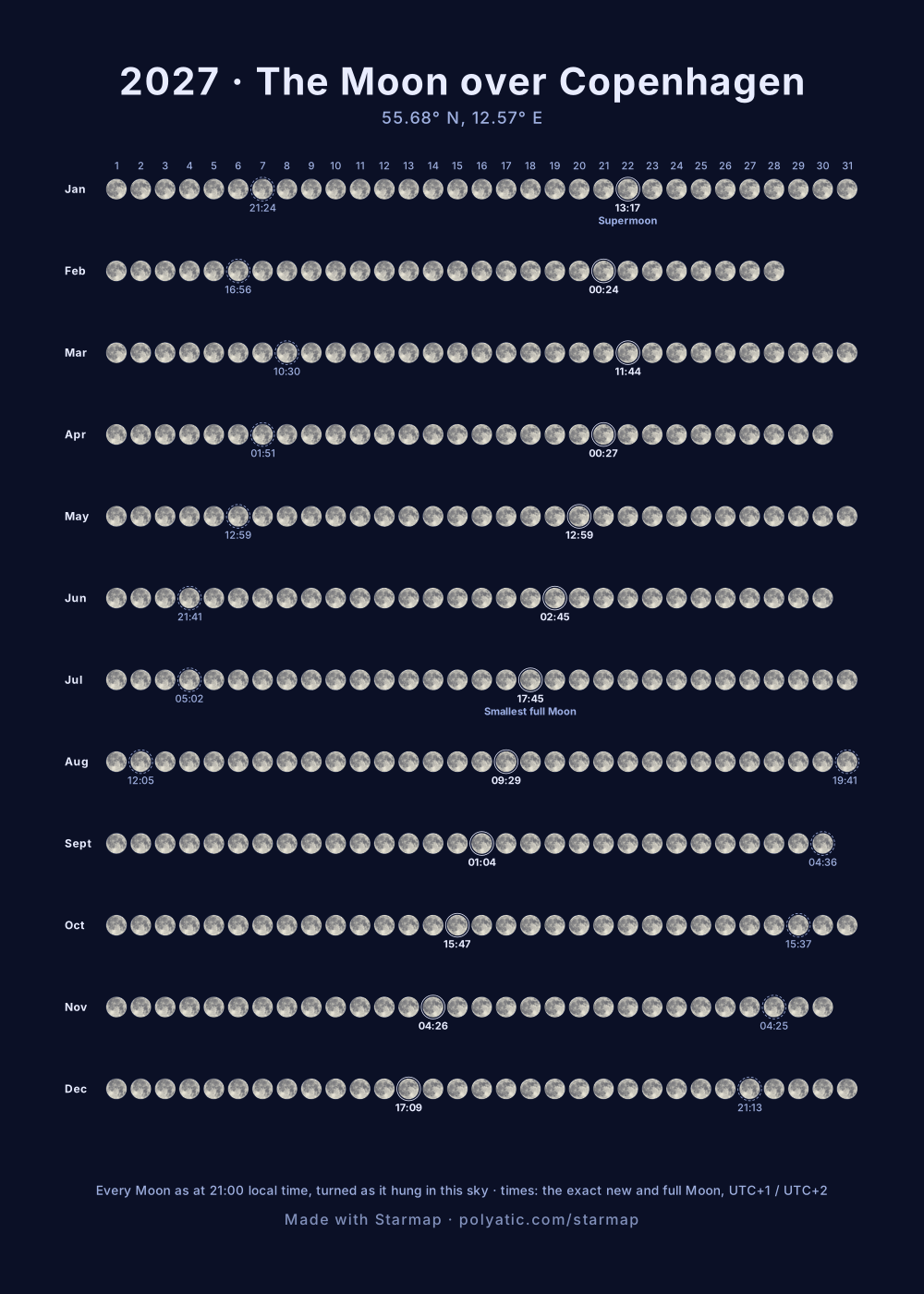
A printable Moon phase calendar is usually a grid of identical icons, the same sheet for everyone on Earth, with the new and full Moons dated in Universal Time or in US Eastern time. That is close enough most nights and wrong on the ones people circle. This calendar is computed for one town: the dates and times are that town’s, summer time included, and each Moon is drawn the way it looked from there.
Why the calendar depends on your town
The date flips near midnight. A full Moon is one instant, the moment the Moon stands exactly opposite the Sun, and what day that instant falls on depends on your clock. The February 2027 full Moon comes less than an hour before midnight on 20 February in Universal Time. In New York that is 18:24 on the 20th; in Copenhagen it is 00:24 on the 21st; in Sydney 10:24 on the 21st. In October it goes the other way: 15:47 on 15 October in Copenhagen, but 00:47 on 16 October in Sydney. A calendar dated in UTC puts a Copenhagen or Sydney full Moon on the wrong square a few times a year, and you would not know which ones. This one dates each event in the town’s own time zone and switches with summer time: Copenhagen’s times are UTC+1 until 28 March 2027 and UTC+2 from then until 31 October, and the poster prints both offsets under the calendar.
The Moon looks turned over in the southern hemisphere. The phase, how much of the Moon is lit, is the same everywhere at a given moment. Which way the lit side points is not. Seen from Copenhagen, the waxing crescent of 12 March 2027 is lit on the right; seen from Sydney the same evening it is lit on the left, and the dark seas of the face are turned round with it. Every Moon on the calendar is rotated by the angle it really had at 21:00 in your town, so a calendar for Sydney or Cape Town looks like the sky there, not like a northern textbook.
Supermoons and blue moons, in plain numbers
The Moon’s orbit is an ellipse, so its distance swings between about 356,400 and 406,700 km. The calendar calls a full Moon a supermoon when it is closer than 360,000 km, centre to centre, the threshold timeanddate.com and most newspapers use; definitions differ, and the poster says which one it uses. 2027 has exactly one: 22 January, at 357,644 km. The calendar also names the year’s smallest full Moon, 18 July 2027 at 405,973 km. Side by side the January Moon looks about 13 % wider, a difference you see in photographs taken with the same lens and almost never by eye.
A blue moon here is the second full Moon in one calendar month. Full Moons come every 29.5 days, so a month of 30 or 31 days gets two only when the first falls on its first day or two, roughly once every two to three years. Because it depends on the date, it depends on the town: the full Moon of 31 December 2028, at 17:48 in Copenhagen, makes a New Year’s Eve blue moon in Copenhagen, London and New York, but in Sydney and Tokyo the same instant falls on 1 January 2029. Sydney gets no blue moon in December 2028 and two in 2029 instead, on 30 January and 30 March, with no full Moon at all in February. 2027 has no blue moon anywhere. (An older almanac rule calls the third of four full Moons in one season a blue moon; the calendar uses the monthly rule.)
Open New York 2028 · Open Sydney, March 2029, as a month
What each Moon shows, and what it does not
Every night is drawn as at 21:00 on the town’s clock, the hour most people look up. The Moon is not always up at 21:00: in Copenhagen in 2027 it is below the horizon at that hour on 195 of the 365 nights, mostly in the waning half of the month, when it rises later each night. The calendar still draws those Moons, lit and turned as they would be at 21:00, so read it as a calendar of phases, not a promise that the Moon is in view. For when it rises and sets on one night, use the Moon phase calculator. The face is NASA’s Lunar Reconnaissance Orbiter map, the same on every night; the Moon’s slight nodding (libration, up to about 8°) is not applied night by night, which at the size a calendar Moon prints is under a pixel. Cloud, of course, is not on it.
Printing it
- A4 or US Letter, year view: twelve rows of Moons about 4.6 mm across, with the new and full Moon times in small print under them. It fits on one sheet from a home printer; print at 100 %, not “fit to page”, since the PDF is already the real page size.
- 50 × 70 cm poster: the Moons are about 11 mm across and the face stays sharp: it is a 256-pixel image drawn that small, close to 600 pixels per inch. Send the PDF to a print shop, or use Print at home on A4 / Letter sheets to get the same poster on 9 A4 sheets that overlap by 10 mm and tape together. 30 × 40 cm, 18 × 24 in and the other frame sizes are in the same menu.
- One month at a time: switch the calendar to Month and it draws the month of your date as a seven-column calendar with much larger Moons: one sheet a month on the fridge, or a phone wallpaper.
Dark navy is the default; the ink and sepia themes print the same calendar on a light page and use far less toner. A past year works too: type a birth year and the heading reads “Every Moon of 1989, from Aarhus”.
For a single night as a large poster, see the Moon the night you were born; for the stars as well, the printable star chart for tonight.
What the chart draws
The chart holds the 1,630 stars brighter than magnitude 5.0 and the 89 constellation figures, and the Milky Way is drawn as a soft band. The Moon is drawn in its real phase, and left off when it was below your horizon. The five naked-eye planets, Mercury, Venus, Mars, Jupiter and Saturn, are drawn where they stood. The Sun is drawn too whenever it was up, and the caption says whether your moment was daylight, twilight or full dark: the stars are always drawn where they stood, even when daylight or twilight hid them. So is an eclipse, if your moment falls inside one. Uranus, Neptune and 133 deep-sky objects are one switch away: tick Deep-sky objects and the chart marks the Messier objects and southern showpieces and adds Uranus and Neptune (see this page’s example with them). Great comets since 1900 can be added (Hale-Bopp over London, 1997). Not drawn: faint comets and satellites, whose orbits this tool does not compute. Every position is carried to your date by precession. Not modelled: the stars’ own proper motion. A date before 15 October 1582 is read in the Julian calendar. It all runs in your browser, nothing is uploaded, and the downloads are complete and free. Accuracy, print sizes and privacy, answered in full.
Common questions
Is this the same Moon calendar for everyone?
No. The phases are the same everywhere at one instant, but the date each new and full Moon falls on, its printed time and the way every Moon is turned depend on the town. The February 2027 full Moon is on 20 February in New York and on the 21st in Copenhagen and Sydney.
Which years can I print?
Any year from 1 to 3000, one page for each. Type it in the Year box at the top: the box starts on the coming year (next year from October on), and the two buttons beside it pick this year or next with one tap. Dates before 15 October 1582 are read in the Julian calendar, as they were written at the time.
How accurate are the new and full Moon times?
The test suite checks every 2027 new and full Moon against the U.S. Naval Observatory’s published table: each lands on the right local date in Copenhagen and Sydney and its printed time is within 2 minutes. The lit part of every drawn Moon is within 2 % of the computed phase at 21:00.
Why does the Moon on my calendar look upside down?
If your town is south of the equator, the Moon you see is turned round compared with the one in northern books, and the calendar draws it the way you see it. In Sydney the waxing crescent of 12 March 2027 is lit on the left; in Copenhagen it is lit on the right.
Does it show moonrise and moonset times?
No. It is an astronomy calendar of the phases: each night's Moon, lit and turned, and the exact new and full Moons, supermoons, a blue moon and the year's smallest full Moon. For moonrise, moonset and the percentage lit on one date, use the Moon phase calculator.
Does it cost anything?
No. The calendar, the SVG, the 300 dpi PNG, the print-size PDF and the tiled A4 version are free, with no account. Nothing is uploaded: the whole year is computed in your browser.