Every Great Comet Seen From Your Town Since 1900
The list above starts on a town guessed from your device’s time zone; type your own town and pick it, and the list is worked out again for that latitude and longitude: which of the great comets since 1900 your town could see in a dark sky, when in the evening or the morning, the night each one was best, how bright it got there, a small drawing of it over your horizon, and a link that makes a poster of that night’s sky.
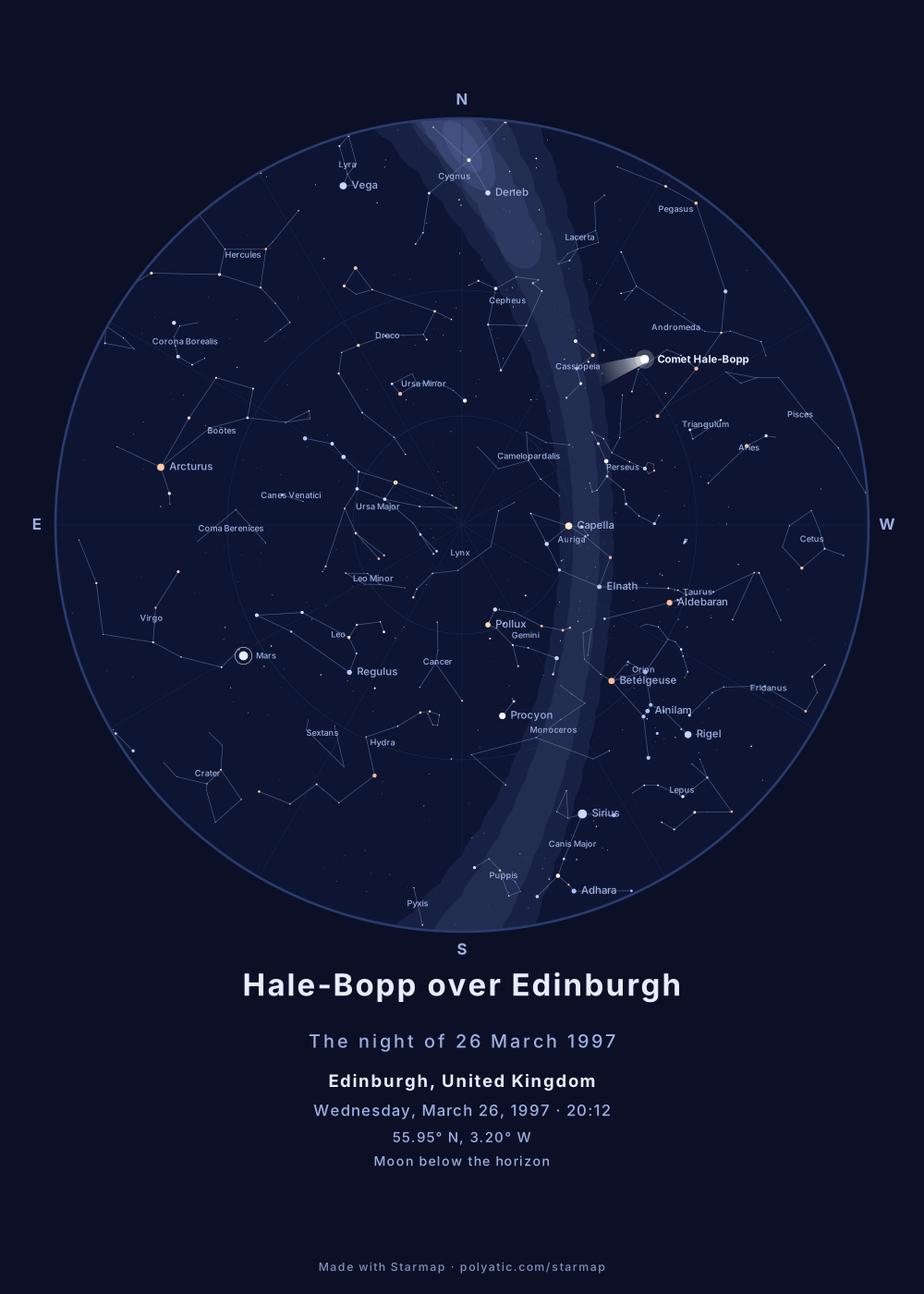
Open Hale-Bopp over Edinburgh, 26 March 1997
Free, in your browser: no account and nothing uploaded. The button opens the poster pictured below with Great comets ticked; each row in the list above opens the same kind of poster for your own town and that comet’s best night. Downloads: a vector SVG, a 300 dpi PNG and a PDF at the size you choose.
What counts as “seen from your town”
A comet is listed for a town only if, on at least one night, three things were true at the same moment: its total brightness was better than magnitude 3, it stood more than 10° above that town’s horizon, and the Sun was at least 12° below the horizon, which is where nautical dusk ends and the sky is properly dark. The list checks every night of each comet’s apparition in 20-minute steps. Magnitude 3 is a comet you could find without binoculars from a small town; 10° is roughly a fist at arm’s length, enough to clear most roofs and trees. The window on each row gives the first and last evening, and the first and last morning, that passed the test; the best night is the one on which the comet was brightest while passing it, and its poster opens at the moment it stood highest that night.
Comets that never passed are not dropped silently. They are listed after the others under “Not visible from” your town, with the reason: never high enough in a dark sky, too faint whenever it was up, or bright only in twilight. That last group is real: from Copenhagen, Halley’s Comet in May 1910 and PANSTARRS in March 2013 were naked-eye objects low in the west after sunset, but only while the Sun was 6 to 12° down, so they are named with their best twilight night rather than counted. From Paris the Great January Comet of 1910 reached magnitude −1.2 on the evening of 23/24 January 1910, 10° up in the west with the Sun 6° down, but once the Sun was 12° down it never stood higher than 8°: a twilight comet there, with its poster link all the same. A comet that was up in a dark sky but fainter than magnitude 3 gets a poster link too, since the poster draws anything brighter than magnitude 5.
Which comets are on the list
“Great comet” has no formal definition, so the list follows two published ones: JPL’s table of Great Comets in History and Wikipedia’s list of great comets. Every comet either of them names from 1900 on is here, 20 great comets in 21 apparitions: Great Comet of 1901 1901, Great January Comet 1910, Halley's Comet 1910, Skjellerup-Maristany 1927, Great Southern Comet 1947, Eclipse Comet 1948, Arend-Roland 1957, Mrkos 1957, Seki-Lines 1962, Ikeya-Seki 1965, Bennett 1970, West 1976, Halley's Comet 1986, Hyakutake 1996, Hale-Bopp 1997, McNaught 2007, Lovejoy 2011, PANSTARRS 2013, NEOWISE 2020, Tsuchinshan-ATLAS 2024 and ATLAS 2025. Halley’s faint 1986 return and PANSTARRS in 2013, on neither list, are kept because so many people went out to look for them. Comets that reached the naked eye without making either list, such as Kohoutek in 1973–74 or IRAS–Araki–Alcock in 1983, are not in the engine.
Six towns, side by side
| Town | Great comets seen | Brightest there | Hale-Bopp’s best night (magnitude, nights seen) |
|---|---|---|---|
| Edinburgh | 9 of 21 | Hale-Bopp 1997, −0.4 | 26/27 March 1997, −0.4 (111 nights) |
| Copenhagen | 9 of 21 | Hale-Bopp 1997, −0.4 | 26/27 March 1997, −0.4 (112 nights) |
| New York | 11 of 21 | Hale-Bopp 1997, −0.4 | 26/27 March 1997, −0.4 (117 nights) |
| Los Angeles | 10 of 21 | Hale-Bopp 1997, −0.4 | 26/27 March 1997, −0.4 (119 nights) |
| Cape Town | 10 of 21 | Eclipse Comet 1948, 0.8 | 23/24 May 1997, 1.9 (7 nights) |
| Sydney | 10 of 21 | Great Comet of 1901 1901, 0.8 | 24/25 May 1997, 1.9 (7 nights) |
Hale-Bopp is the comet most people remember, and the table shows why: from Edinburgh it passed the test on 111 nights between January and April 1997, in the morning sky first and then in the evening, peaking at magnitude −0.4. Comet Hyakutake, a year earlier, came within 0.1 au of the Earth and stood 73° up over Copenhagen on its best night, 25/26 March 1996. NEOWISE in July 2020 scrapes onto the northern lists with only a handful of nights, because at 56° north the Sun barely gets 12° below the horizon in July.
Why the southern hemisphere missed Hale-Bopp, and the north missed McNaught
Whether a town sees a comet depends first on the comet’s declination, its distance north or south of the celestial equator, just as for a star. On 26 March 1997 Hale-Bopp stood at declination +46°: from 56° north it never set, while from Sydney, 34° south, something that far north climbs at most 10° above the northern horizon, and only in daylight or bright twilight at that season. By late May it had moved south enough to clear 10° in a dark sky from Sydney for 7 nights, at magnitude 1.9 at best, a pale echo of the northern spring. Comet McNaught in January 2007 was the mirror image: after passing the Sun it swung far south, to declination -38° on 20 January, and its great curved tail filled the evening sky over Australia, South America and southern Africa while Europe saw it, briefly, only low in the dusk before perihelion.
How the magnitudes are estimated
No comet’s brightness can be computed from first principles, so each apparition carries its own law: magnitude = M1 + 5 log Δ + K1 log r, where Δ is the comet’s distance from the Earth and r from the Sun, both in astronomical units. The laws come in two grades. For 16 of the 21 apparitions, M1 and K1 are fitted to the daily medians of visual estimates in the Comet OBServation database (COBS, which holds the International Comet Quarterly archive back to the 1950s): 577 nights of observations for Hale-Bopp, which the law follows to 0.4 magnitudes, and 0.3 to 1.1 for the others. Treat those figures as good to about half a magnitude.
4 rest on historical estimates instead: Great Comet of 1901 1901 (2 dated magnitudes), Great January Comet 1910 (5 dated magnitudes), Skjellerup-Maristany 1927 (4 dated magnitudes) and Great Southern Comet 1947 (15 dated magnitudes). Those comets predate the archive, or have too few nights in it, so their laws are fitted to the handful of dated brightness estimates published for them, often whole magnitudes from a few observers, and are much rougher: good to about 1 to 1.5 magnitudes. Two of the published figures are left out of the fits on purpose: the Great January Comet at −4 in daylight on 17 January 1910 and Skjellerup-Maristany at −6 on 16 December 1927 stood almost between the Sun and the Earth, and sunlight scattered forward by their dust made them far brighter, for a day or two, than any such law. Halley’s 1910 apparition uses the published pair for JPL’s 1910 orbit.
The figure is the brightness of the whole head as if squeezed into a point; a diffuse comet of magnitude 3 looks fainter than a star of the same number, and a long tail can be the real sight while the head is faint. One law cannot follow a sudden outburst or the brief flare when a comet passes between the Sun and the Earth, which Tsuchinshan-ATLAS, McNaught and ATLAS in January 2025 all did.
What the poster of that night draws
Each row’s link opens the star-map generator on your town at that night’s best moment with Great comets ticked (comets=1). The comet’s head is drawn where JPL’s orbit puts it, checked to within 0.1° of JPL Horizons, and its tail points away from the Sun along the computed direction; the tail’s length and curve are illustrative, since dust tails bend and their visible length depends on the sky. Title, colours and size are yours to change. The stars are the 1,630 of the Yale Bright Star Catalogue, precessed to the night you pick; their own proper motion is not modelled, and since 1900 it has shifted none of them by an amount the eye could see. The generator also reads any date before 15 October 1582 in the Julian calendar, so a poster of an older apparition of Halley’s Comet uses the calendar of its day, though the comet itself is drawn only for the 21 apparitions named above. The Milky Way is drawn as a soft band under the stars, five steps from its faint edge to its brightest star clouds, and clipped at the horizon like everything else. Its centre line is the galactic equator, computed with the same math as the stars, so it runs where the sky has it: through Cygnus, Aquila and Sagittarius in a northern summer, through Auriga, Gemini and Puppis on a winter night. Its edges and star clouds are a hand-drawn sketch of the naked-eye band, not a traced photograph, so treat them as a guide to where to look, not a brightness map; a checkbox turns the band off. The Moon is drawn at its real altitude, azimuth and phase for your moment, and left off entirely when it was below your horizon. So are the five naked-eye planets: Mercury, Venus, Mars, Jupiter and Saturn are drawn where they stood, sized by how bright each was that night, labelled, and shown only when above your horizon. The Sun is drawn too whenever it was above your horizon, and the line under the chart says whether that moment was daylight, civil, nautical or astronomical twilight, or full dark, with the Sun’s altitude: the stars are always drawn where they stood, even when daylight or twilight hid them. If your moment falls inside a solar or lunar eclipse seen from your place, the eclipse is drawn as well: the Moon over the Sun, to scale, or the Moon in the Earth’s shadow. Uranus, Neptune and 133 deep-sky objects are one switch away: tick Deep-sky objects and the chart marks all 110 Messier objects and 23 southern and binocular showpieces (Omega Centauri, 47 Tucanae, both Magellanic Clouds, the Carina Nebula and more) with star-atlas symbols and labels such as M31 and M42, and adds Uranus and Neptune — open this page’s example with it ticked. Most of them are binocular targets: only a handful, such as M31, M42, M45 and Omega Centauri, show to the naked eye from a dark site, Uranus (about magnitude 5.7) only to a sharp eye, and Neptune (about 7.8) only in binoculars. Great comets since 1900 can be added (Hale-Bopp over London, 1997). Not drawn: faint comets and satellites, whose orbits this tool does not compute.
Limits worth knowing: only the 21 apparitions named above are in the engine; a comet outside them is absent, never guessed. Clouds, moonlight and light pollution are not counted, and the times use your town’s time zone as the browser knows its history. For eclipses over your town see every eclipse from your town; for the whole sky of any past date, what the sky looked like.
Common questions
Why did a southern-hemisphere town miss comets the north saw?
Because each comet sat at its own declination. Hale-Bopp was about 46° north of the celestial equator at its best, so from Sydney it barely rose above the northern horizon in a dark sky until late May 1997, when it had faded to magnitude 1.9. McNaught in 2007 went the other way, to -38°, and was a southern sight.
Why is the tail called illustrative?
The tail’s direction is computed: it points away from the Sun, as a comet’s gas tail does. Its length, width and curve are not modelled; real dust tails bend along the orbit, and how much of a tail you see depends on the darkness of your sky. The drawing on each row and the poster both show the direction honestly and the length as a sketch.
How are the magnitudes estimated?
From a brightness law fitted per comet, using the comet’s distances from the Sun and the Earth on each night. For 16 of the 21 apparitions the law is fitted to the visual estimates in the COBS database and follows the nightly medians to 0.3 to 1.1 magnitudes. Great Comet of 1901 1901, Great January Comet 1910, Skjellerup-Maristany 1927 and Great Southern Comet 1947 rest on the few dated estimates published for them, from two to fifteen each, and are rougher, good to about 1 to 1.5 magnitudes; Halley 1910 uses JPL’s published pair. No law follows outbursts, so treat each figure as approximate.
Comet Lovejoy filled Australia’s dawn sky in December 2011. Why is it under “Not visible” from Sydney?
Because what people saw was the tail. Lovejoy grazed the Sun on 16 December 2011 and its head faded fast in the days after; by the time it climbed more than 10° above Sydney’s horizon in a dark sky, the head was about magnitude 4.0, under the list’s magnitude-3 bar, while a tail tens of degrees long stood up from the south-eastern dawn. Its row says so and links the poster of 24/25 December 2011, which draws the comet where it stood; the tail’s length is not modelled. From Europe and most of North America it never rose in a dark sky at all.
Why is Halley’s Comet in 1986 not on my list?
It was a poor return: the Earth was on the far side of the Sun when Halley was brightest, and the fitted law puts it at magnitude 3.3 at best from Sydney and fainter from northern towns, while it was up in a dark sky. It was seen from dark sites, but it never passed the magnitude-3 test, so it is listed under “Not visible” with that reason.
Is anything sent anywhere?
No. The list is computed on your own device from the orbits loaded with the page; the first town is guessed from your time zone’s name, never your location, and the town list loads only once you type. There is no account and the downloads are free.