A Moon Phase Print of Your Days
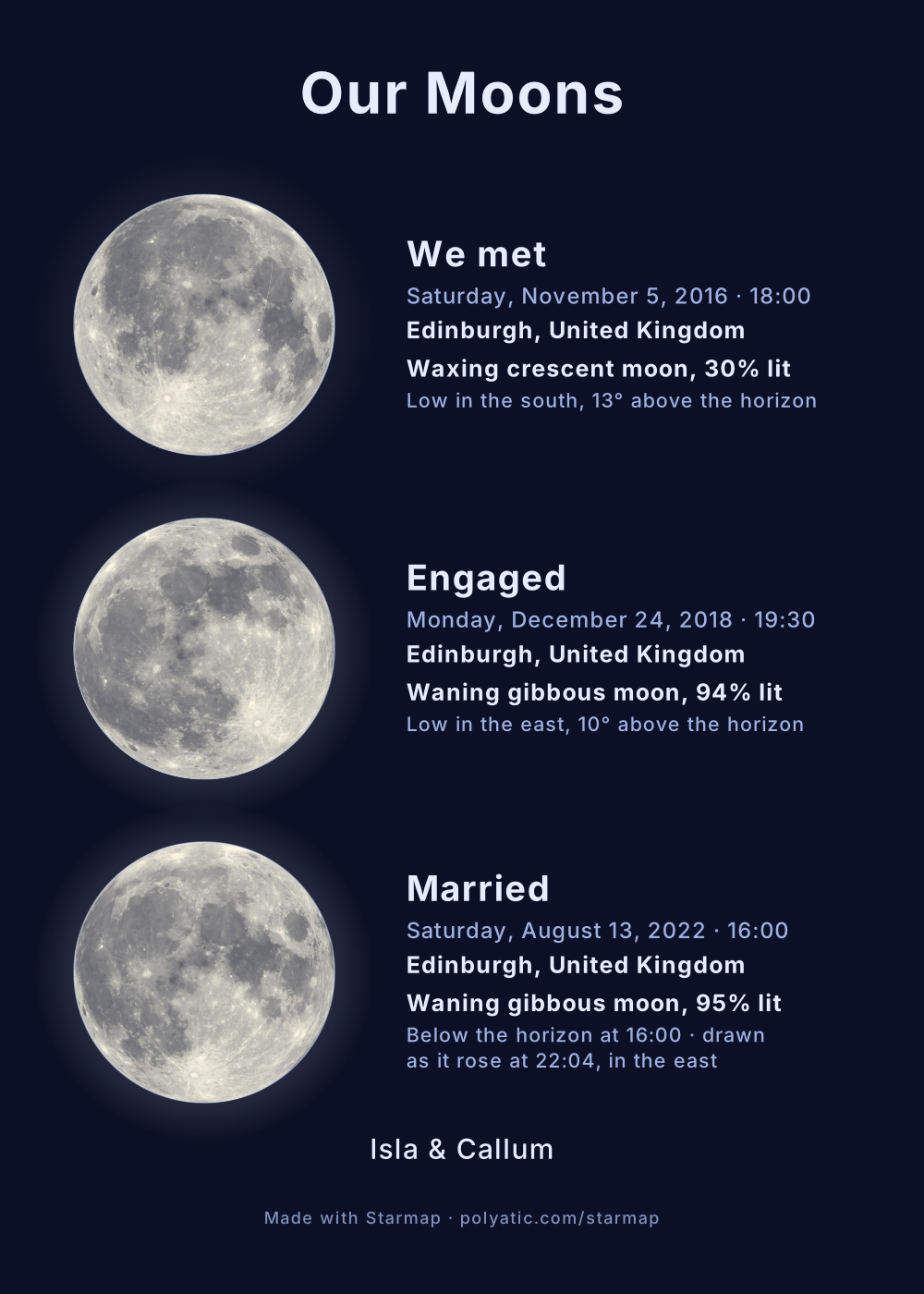
Type the days that made you a couple and the print draws the Moon of each one, one under the other: how much of it was lit, and the way it was turned in the sky over the town where it happened, at the hour you give. Label each Moon (“We met”, “Engaged”, “Married”), add a title and a dedication, and download it as PNG, PDF or SVG.
Start a Moons print
Free, no account, nothing to buy. Opens Moons of your days with three days; give each its label, date, time and town there, or use the form at the top.
Not a phase icon: the Moon those two people could have looked up at
Most Moon phase prints take a date, round its phase to one of eight stock pictures and print the icon: a crescent standing upright, lit on the right when it is growing. That picture belongs to no place and no hour. This print starts from the moment instead. For each day it works out how far the Moon was from the Sun (which sets the percentage lit), where it stood above the town you named (height and compass direction), and which way its bright edge pointed from that spot. The face is drawn from NASA’s map of the lunar surface, so the dark seas sit where they really were that night.
The same Moon, two towns
At 18:00 GMT on 5 November 2016 the Moon was a waxing crescent, 30 % lit, everywhere on Earth. From Edinburgh it hung 13° up in the south with its lit edge facing right and a little down, as on the left of the sample. At that same instant it was 21:00 in Nairobi, almost on the equator, where the same crescent stood 27° up in the west lit from below, lying on its back like a bowl. A stock icon draws both the same way. That is why the town matters even when the date is fixed, and why each day on the print has its own town box.
Making yours
- Two days are needed, four is the most. On a portrait or square print two or three stack down the sheet, each with its label, date, town and phase beside it; on a landscape screen they sit in a row. Four make a two-by-two grid.
- Give each day its hour if you know it. The phase barely moves in an hour (about half a percent), but the Moon’s height and tilt change all evening. If you only know the date, an evening hour such as 21:00 is a fair guess for a first meeting.
- The labels hold up to 30 characters and sit above that Moon’s date, town and phase line. The title goes on top, and up to three lines of dedication go under all of them.
- Different towns are fine. The form here puts every day in one town; in the generator each day has its own town box, and its time is read on that town’s clock, summer time included.
What the print leaves out
It shows the Moon only: no stars, planets or constellations around it (the one-day Sky & Moon poster does that). It does not draw an eclipse shadow on the face, so a wedding during a lunar eclipse looks like an ordinary full Moon. A Moon that was up in daylight is drawn on the print’s own background, not against a blue sky; its caption gives its height above the horizon.
What the chart draws
The chart holds the 1,630 stars brighter than magnitude 5.0 and the 89 constellation figures, and the Milky Way is drawn as a soft band. The Moon is drawn in its real phase, and left off when it was below your horizon. The five naked-eye planets, Mercury, Venus, Mars, Jupiter and Saturn, are drawn where they stood. The Sun is drawn too whenever it was up, and the caption says whether your moment was daylight, twilight or full dark: the stars are always drawn where they stood, even when daylight or twilight hid them. So is an eclipse, if your moment falls inside one. Uranus, Neptune and 133 deep-sky objects are one switch away: tick Deep-sky objects and the chart marks the Messier objects and southern showpieces and adds Uranus and Neptune (see this page’s example with them). Great comets since 1900 can be added (Hale-Bopp over London, 1997). Not drawn: faint comets and satellites, whose orbits this tool does not compute. Every position is carried to your date by precession. Not modelled: the stars’ own proper motion. A date before 15 October 1582 is read in the Julian calendar. It all runs in your browser, nothing is uploaded, and the downloads are complete and free. Accuracy, print sizes and privacy, answered in full.
Common questions
Why is my Moon tilted differently from the ones in shops?
Shop prints use a fixed icon whose bright side points straight left or right. The real Moon’s bright side points towards the Sun, and how that looks to you depends on where you stand and where the Moon is in your sky. In the sample, the 5 November 2016 crescent seen from Edinburgh is lit on its lower right; at the same instant from Nairobi it was lit from underneath. Each Moon on this print is turned the way it stood above the town you typed, at the time you typed.
What if the Moon was below the horizon at that hour?
Then nobody in that town could have seen it, and the print says so rather than pretending. The Moon is drawn as it looked when it next rose there, and its caption says both facts. In the sample the wedding was at 16:00 on 13 August 2022; the 95 % waning gibbous Moon was below the Edinburgh horizon, so the caption reads “Below the horizon at 16:00 · drawn as it rose at 22:04, in the east”. Its phase is still that day’s.
What does the percentage lit mean?
The share of the Moon’s visible disc that the Sun lit at that moment: 0 % at new Moon, 50 % at first and last quarter, 100 % at full Moon. A “quarter” Moon is therefore half lit; the name counts a quarter of the Moon’s 29.5-day cycle, not a quarter of the disc. The number moves by up to about 12 percentage points a day near the quarters and much more slowly near full and new, which is why two dates a few days apart around a full Moon can both read 94–99 %.
We met abroad and married at home. Can each Moon have its own town?
Yes. The form on this page puts every day in one town; in the generator each day has a town box of its own, so type the other town there. A Moon’s phase is the same everywhere at a given instant, but its height, direction and tilt are not, and the clock time you type is read in that town’s own time zone, summer time included.
How large does each Moon come out?
On a 50 × 70 cm print three Moons are each about 14 cm across with a one-line dedication (15 cm with none, 13 cm with three lines); on A4 three are about 6 cm and two about 7.5 cm. The labels grow with the Moons: on 50 × 70 cm their capitals are over 1 cm tall, on A4 about 5 mm. The PDF and SVG are vector, and the PNG is 300 dpi at the size you pick, so a home printer works for A4 and US Letter.