Birth Star Map — Your Baby's First Sky
A birth is one of the few moments in life recorded to the minute. That makes it the perfect star map: no guessing, just the documented instant and the sky that stood over it.
Make the birth star map
Free, in your browser — no account, nothing uploaded. Both downloads are the complete chart: a vector SVG and a 300 dpi PNG, with nothing held back and nothing to buy.
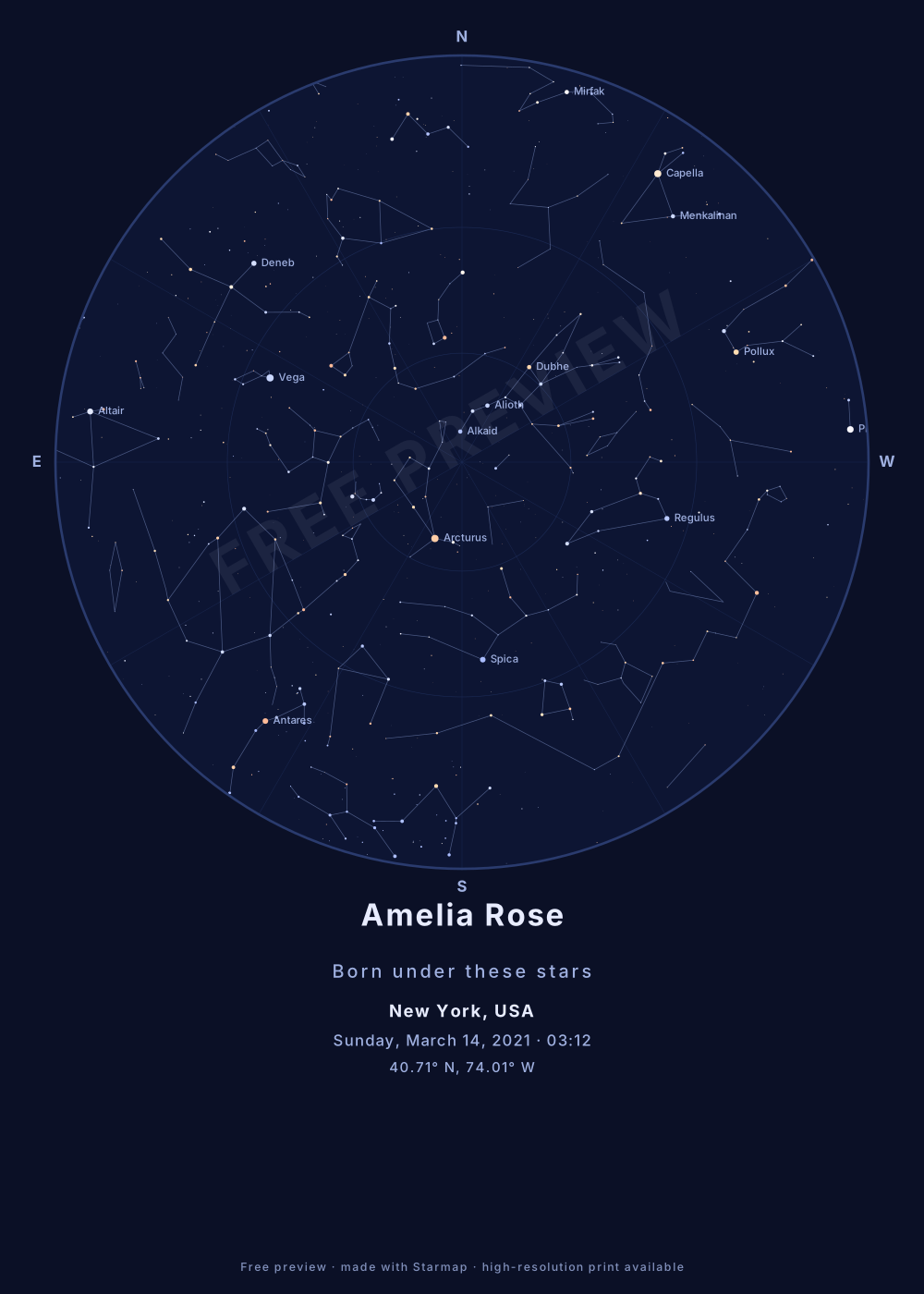
Take the date, time and city from the birth record, enter them, and the generator computes the sky over the hospital at that minute. The baby's name becomes the title; “The night you were born” (or the weight, or a blessing) becomes the subtitle; the place line shows the city or the exact coordinates.
It hangs well in a nursery in either theme — the navy chart reads as night itself, while the ink-on-paper version matches softer décor and costs less to print. Grandparents get the duplicate; that is apparently the law.
How the map is computed
You give it three things: a date, a time, and a place. For the place, type a town or city name and pick it from the list — 29,919 towns and cities of 18,000 people or more, from GeoNames — or enter an exact latitude and longitude instead. Accents are optional (“malmo” finds Malmö), but type the name on its own: “Roskilde Denmark” finds nothing, and a typo finds nothing rather than the wrong sky.
Your date, time and place are converted to a Julian Date and then to local sidereal time — the astronomer’s clock for “which way is the sky facing.” Each of the 1,630 stars in the Yale Bright Star Catalogue (every star brighter than magnitude 5.0, i.e. every star a good naked eye can see) is transformed to its altitude and azimuth at that exact moment, and every one of those stars above the horizon is projected onto the circular chart: zenith at the centre, horizon at the rim, north at the top — and east on the left, because a star map is read looking up, which mirrors east and west compared to a ground map.
The 89 constellation figures are drawn with the same math and clipped at the horizon. Star dots are scaled by real brightness (magnitude) and tinted by star colour. The Moon is drawn at its real altitude, azimuth and phase for your moment, and left off entirely when it was below your horizon. It does not show the planets, comets or satellites — those wander against the fixed stars and need ephemerides, which this version does not compute. Everything runs in your browser — nothing is uploaded, there is no account, and the page works offline once loaded.
Common questions
Does the exact minute really matter?
The sky rotates one degree every four minutes, so minutes barely move the chart — but using the documented minute is the charm of a birth map: it is the one moment in your family recorded that precisely.
We had twins. Two maps or one?
Astronomically the maps are near-identical (a few minutes apart), so one shared chart is honest. Many parents still print two with each name and exact minute — the difference is in the caption, and that's the part that matters.
The birth was in the daytime — is a star map meaningless?
No — the stars were above the horizon in daylight too; the chart shows what the sun outshone. Showing the sky of the moment regardless of daylight is the standard convention for birth maps.