Find Your Birthday Star
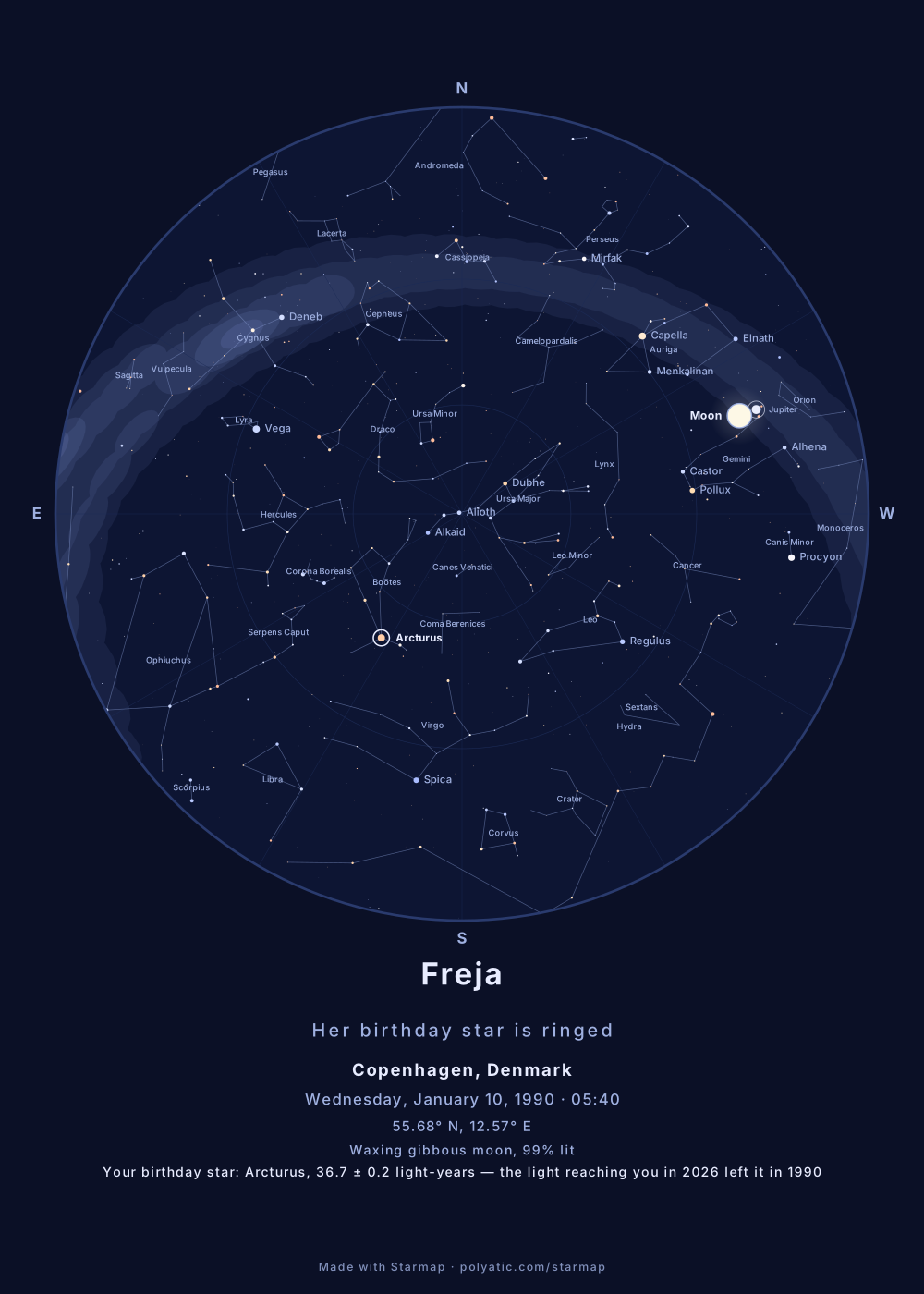
A light-year is the distance light travels in a year, about 9.46 trillion km, so a star 36.7 light-years away is seen by the light that left it 36.7 years ago. Your birthday star is the one whose distance in light-years matches your age: the light from it reaching your eyes this year set out around the time you were born.
Find my star
Free, in your browser — no account, nothing uploaded, nothing to buy. This button opens the generator with Birthday star ticked on the example birthday (10 January 1990, 05:40, Copenhagen); change the date, time and town there to yours, or use the form at the top, which opens it with your own date filled in.
Birthday stars by age
The table gives, for every fifth birthday, the naked-eye star closest in distance to that age. It is computed from the same Hipparcos parallaxes the generator uses (van Leeuwen 2007 reduction), with the measurement uncertainty shown: Arcturus at 36.7 ± 0.2 light-years means the light now arriving left it within about 12 weeks of the date the distance points to. That uncertainty is real and differs a lot from star to star, which is why the table shows it rather than a single tidy number. A star is only listed if its parallax is measured to 10% or better; that keeps 1,417 of the chart’s 1,630 stars.
| Age | Star | Light-years | Light left within | Never rises | Other close matches |
|---|---|---|---|---|---|
| 10 | Ran Eridanus · mag 3.7 | 10.49 ± 0.01 | ± 2 days | north of 81° N | — |
| 15 | Keid (nearest; none within ½ ly) Eridanus · mag 4.4 | 16.26 ± 0.02 | ± 7 days | north of 82° N | 70 Oph, Altair |
| 20 | δ Pav Pavo · mag 3.6 | 19.92 ± 0.02 | ± 8 days | north of 24° N | HR 1008 |
| 25 | Vega Lyra · mag 0.0 | 25.04 ± 0.07 | ± 4 weeks | south of 51° S | Fomalhaut |
| 30 | HR 4523 Centaurus · mag 4.9 | 30.07 ± 0.06 | ± 3 weeks | north of 49° N | κ¹ Cet, γ Pav, β Com +1 more |
| 35 | ζ Her Hercules · mag 2.8 | 34.95 ± 0.18 | ± 9 weeks | south of 58° S | δ Tri |
| 40 | β TrA Triangulum Australe · mag 2.9 | 40.37 ± 0.08 | ± 4 weeks | north of 27° N | λ Ser, ζ TrA, 44 Boo |
| 45 | ι Psc Pisces · mag 4.1 | 44.73 ± 0.09 | ± 5 weeks | south of 84° S | Alshain, 10 Tau |
| 50 | 19 Dra Draco · mag 4.9 | 49.76 ± 0.25 | ± 13 weeks | south of 25° S | 104 Tau, δ Aql, ν Phe |
| 55 | Caph Cassiopeia · mag 2.3 | 54.74 ± 0.35 | ± 4 months | south of 31° S | — |
| 60 | θ Cyg Cygnus · mag 4.5 | 59.80 ± 0.16 | ± 9 weeks | south of 40° S | δ Equ, η Crv, τ PsA +5 more |
| 65 | HR 3220 Carina · mag 4.8 | 65.17 ± 3.45 | ± 3.5 years | north of 29° N | η Cru, ν² CMa |
| 70 | λ Ara Ara · mag 4.8 | 69.96 ± 0.50 | ± 6 months | north of 41° N | ε Cet, HR 2740, 40 Leo +2 more |
| 75 | Alphecca Corona Borealis · mag 2.2 | 75.05 ± 0.48 | ± 6 months | south of 63° S | Sarin, γ Tuc, Dziban |
| 80 | 7 And Andromeda · mag 4.5 | 80.20 ± 0.43 | ± 5 months | south of 41° S | Merak, Kaffaljidhma, Megrez +1 more |
The star closest in distance to each age, from the generator’s 1,417 measured stars, with its Hipparcos uncertainty. The last column lists the other stars within half a light-year of that best match, which the generator may pick instead if one of them was above your horizon. On a phone, swipe the table sideways for the last three columns.
“Never rises” is the part of the world that cannot see the star at any hour or season: β Trianguli Australis, the star for age 40, is never above the horizon from London or New York. That is why the generator does not just take the closest distance. Among all stars within half a light-year of the best match (the last column), it prefers one that was above your birthplace’s horizon at your birth time, so your star can be ringed on the chart of that night.
Where it is in your sky tonight
Under the option, the generator also says where to look for the star tonight from the town you entered, at 22:00 on that town’s clock: a compass direction and a height in degrees, a warning when it is under 10° (trees and haze usually hide it), or, if it is below your horizon tonight, the month when it stands highest at 22:00. For the example above, made on 2 October 2026, it reads: “Where to find Arcturus tonight: at 22:00, 5° above the north-western horizon. It is low there, so you need a clear view down to the horizon.” Arcturus is an evening star of spring and summer in the north: by the following May it is high in the south-east at 22:00, and the line would then send you there instead.
Why your star changes every birthday
You get a year older, so the light you are looking for has to have travelled one light-year further. Each birthday points to a shell one light-year deeper into space, and a different star sits in it. Naked-eye stars are sparse that close to the Sun: nothing is nearer than α Centauri at about 4.3 light-years, and for ages 5–8, 13–15, 18, 21, 23, 31–33, 62 and 68 no star in the list lies within half a light-year. For those years the generator names the nearest star and prints the year its light really set out, instead of pretending to an exact match.
This is also different from a birthday star map, which draws the whole sky over your birthplace at the minute you were born. You can have both on one poster: the chart of your birth night with your birthday star ringed on it, as in the example.
Nobody can sell you a star’s name
Star names used by astronomers are set by the International Astronomical Union (IAU), which maintains the official list of proper names such as Arcturus and Vega; most stars have only catalogue designations such as β TrA or HR 4523. The IAU states that it does not sell star names and that names bought from private registries have no official standing: no observatory or star catalogue will use them. The star in this tool keeps its real name, and finding it costs nothing.
No meaning is read into the star, either. It is a distance measurement, not astrology: the only thing the star has to do with your birthday is how long its light has been travelling.
What the chart draws
The chart holds the 1,630 stars brighter than magnitude 5.0 and the 89 constellation figures, and the Milky Way is drawn as a soft band. The Moon is drawn in its real phase, and left off when it was below your horizon. The five naked-eye planets, Mercury, Venus, Mars, Jupiter and Saturn, are drawn where they stood. The Sun is drawn too whenever it was up, and the caption says whether your moment was daylight, twilight or full dark: the stars are always drawn where they stood, even when daylight or twilight hid them. So is an eclipse, if your moment falls inside one. Uranus, Neptune and 133 deep-sky objects are one switch away: tick Deep-sky objects and the chart marks the Messier objects and southern showpieces and adds Uranus and Neptune (see this page’s example with them). Great comets since 1900 can be added (Hale-Bopp over London, 1997). Not drawn: faint comets and satellites, whose orbits this tool does not compute. Every position is carried to your date by precession. Not modelled: the stars’ own proper motion. A date before 15 October 1582 is read in the Julian calendar. It all runs in your browser, nothing is uploaded, and the downloads are complete and free. Accuracy, print sizes and privacy, answered in full.
Common questions
What is a birthday star?
A star whose distance from us in light-years equals your age. Light from it takes that many years to reach Earth, so the light you see from it this year left it around the time you were born.
How exact is the match?
As exact as the measured distance. Each star in the table shows its Hipparcos uncertainty: for Vega it is about a month either way, for fainter, farther stars it can be years. On top of that the nearest star rarely sits exactly at your age; the generator prints the star's distance and the year its light actually left, so you can see how close it is.
Why is my birthday star in the table different from the one on my poster?
The table takes the closest distance alone. The generator also looks at which stars within half a light-year of that were above the horizon where and when you were born, and prefers one of those, so it can be ringed on your chart. If none was up, it keeps the closest one and says it was below the horizon that night.
Can I name or register my birthday star?
Not officially. Star names are set by the International Astronomical Union, which does not sell names and does not recognise names bought from registries. Your birthday star already has a name or catalogue number, and that is what the poster prints.
Does it work for someone born in the Southern Hemisphere?
Yes. The candidates cover the whole sky, and the generator prefers a star that was above your birthplace's horizon. The “Never rises” column shows which table stars are out of reach from far-northern or far-southern towns.
Does it cost anything?
No. The chart, the birthday star, and the SVG, the 300 dpi PNG and a PDF whose page is the real size you pick, from A4 (21 × 29.7 cm) to a 50 × 70 cm poster, are all free, with no account. Everything is computed in your browser.